
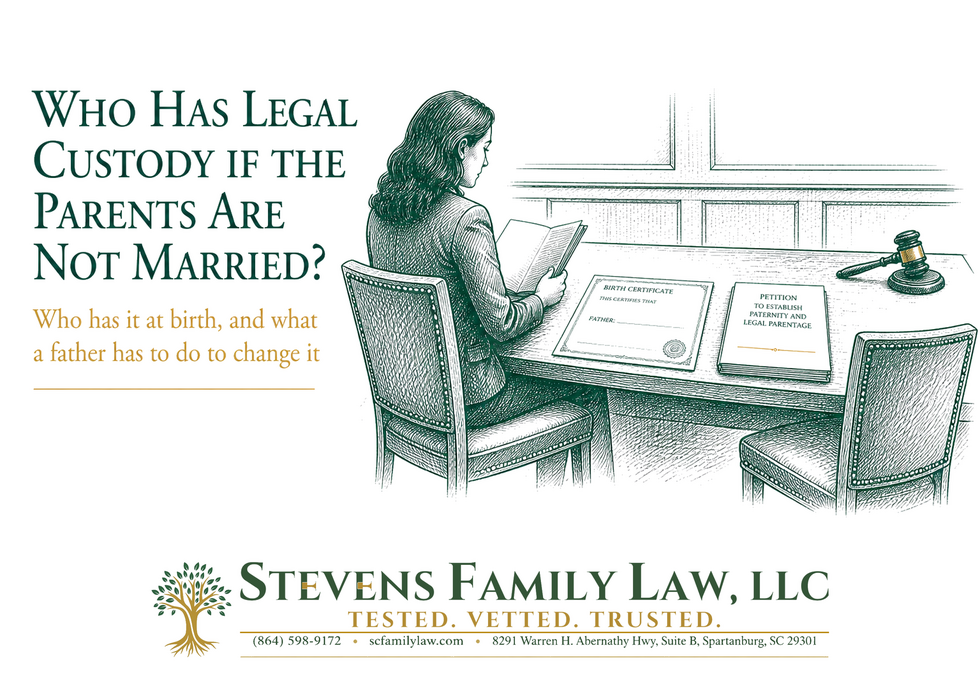
Who has custody at birth, and what a father has to do to change it
When married parents separate, both have equal rights to their children until a judge says otherwise. For unmarried parents, South Carolina law starts from a very different place — and the answer surprises most fathers who ask.
Under state law, custody of a child born to unmarried parents rests solely with the mother unless a court orders otherwise or she has relinquished her rights. (The statute still uses the outdated word "illegitimate"; the legislature has not updated it.) A father may petition for custody or visitation only once paternity has been acknowledged or adjudicated.
This is not a thumb on the scale for mothers. Someone has to have legal custody from the moment a child is born, and the mother's identity is rarely in question. Once a father is properly before the court, he stands on equal footing — and fathers win custody in South Carolina regularly.
Step One: Establishing Paternity
There are three routes, and which one applies matters.
- A voluntary paternity acknowledgment, usually signed at the hospital. This is the most common path and the most powerful — a properly executed acknowledgment creates a legal finding of paternity.
- An administrative process through DSS Child Support Services, which can arrange genetic testing and establish paternity without a courtroom.
- A family court action, brought by either parent, the child, or DSS. A genetic test showing a 95 percent or higher probability creates a rebuttable presumption of paternity.
A word about the birth certificate. In South Carolina, an unmarried father's name generally cannot be added to it unless a sworn acknowledgment is signed or paternity is adjudicated — so the certificate is usually evidence that one of those things happened. Standing alone, though, it creates only a rebuttable presumption, and it confers no custody rights at all.
If you sign an acknowledgment, understand the clock. You have sixty days to rescind it — or until an administrative or court proceeding about the child begins, whichever comes first. After that, it can be challenged only for fraud, duress, or a material mistake of fact, and the burden falls on whoever is challenging it. Sign it if it is true. Do not sign it to keep the peace.
What paternity does (and does not) do
Establishing paternity does not give a father custody or visitation. It gives him standing to ask for them, in a separate action from the paternity case itself. The acknowledgment form does not mention custody for exactly this reason.
It does, however, trigger financial obligations immediately — and since a 2023 change in the law, those reach back further than most people expect. A biological father's support obligation now runs from the date of conception, and he is responsible for half of the mother's pregnancy expenses. Both parents should factor that in before either one files anything.
Step Two: The Custody Decision
Once a father has standing, the court decides custody on the best interest of the child, weighing seventeen statutory factors — among them each parent's ability to meet the child's needs, the child's relationships and adjustment, each parent's willingness to support the child's relationship with the other, any history of abuse or domestic violence, and the child's own preferences.
The court may award joint custody or sole custody. South Carolina has no presumption either way, though when custody is contested the judge must consider all options and explain the reasoning. Each parent files a parenting plan, and in a genuinely disputed case the court may appoint a guardian ad litem to investigate and report.
Once an order is in place, both parents are joint natural guardians with equal rights — including equal access to school and medical records and the right to participate in school activities, unless the order says otherwise.
One more thing that changed
South Carolina abolished common law marriage in 2019. Couples already common-law married before July 24 of that year remain married, but no one can become married by living together after it. For unmarried parents, that closes the last informal path around all of this — establishing paternity is now the only way a father gets legal standing to his own child.
Stevens Family Law, LLC represents parents in custody and paternity matters throughout South Carolina. These cases turn entirely on their own facts, and they are far too consequential to guess at or to model on what happened to a friend. If you are facing one, we would be glad to talk with you. You can contact our office by phone at (864) 598-9172 or online at www.scfamilylaw.com.
This article is general information, not legal advice, and reading it does not create an attorney-client relationship. It reflects South Carolina law as of September 2026. For advice about your situation, please consult a licensed attorney.



Comments
There are no comments for this post. Be the first and Add your Comment below.
Leave a Comment