
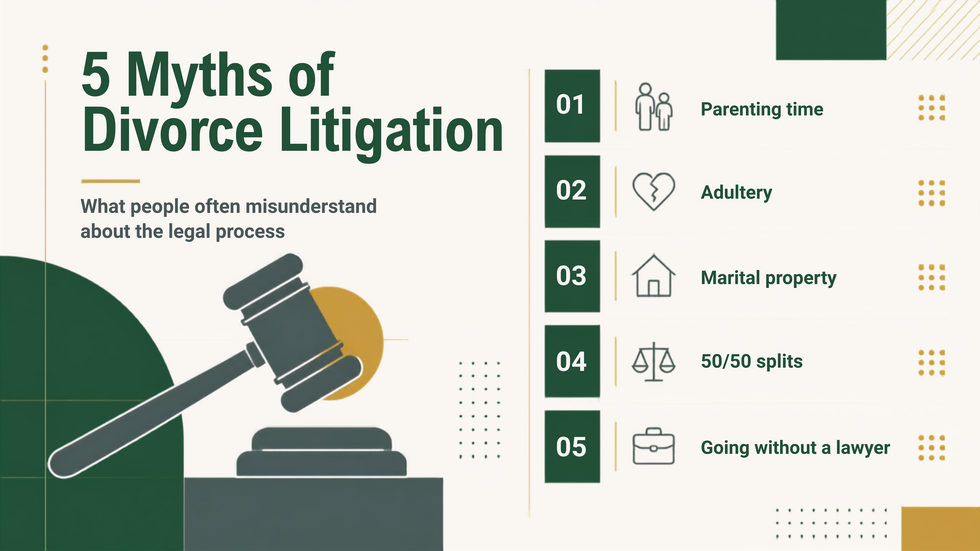
Five things South Carolina clients often get wrong about divorce — parenting time, adultery, marital property, 50/50 splits, and going without a lawyer.
Divorce is not an everyday occurrence for most people. Because of that, clients usually arrive with firm ideas about how their case will unfold — ideas picked up from television, from social media, or from a friend or family member who went through a divorce somewhere else. Some of those ideas are close to right. Many are not, and the gap between expectation and South Carolina law is where a lot of unnecessary stress comes from.
Below are five of the most common misconceptions we hear in initial consultations, along with what South Carolina law actually says.
Myth #1: "My spouse barely spent time with the children, so the court won't give them much parenting time."
Clients who carried most of the day-to-day parenting during the marriage often assume that history alone will control the parenting schedule after separation. It matters, but it is one input among many.
South Carolina family courts decide custody based on the best interest of the child, and the court weighs a list of factors that includes each parent's past and current relationship with the child, each parent's capacity to meet the child's needs, each parent's ability to be actively involved, the child's adjustment to home and school, the stability of each proposed residence, and any history of abuse, neglect, or domestic violence.
The court may award joint or sole custody and may allocate parenting time separately from the custody designation. In contested cases, each parent files a proposed parenting plan. There is no presumption favoring mothers over fathers: the “tender years” doctrine was abolished decades ago, and mothers and fathers hold equal rights and duties as to custody, with neither parent's right paramount to the other's.
What has changed: There has a great deal of public conversation about equal parenting time, and it is worth being precise about where the law stands. As of August 2026, South Carolina law contains no presumption that equal or near-equal parenting time is in a child's best interest. Courts today decide these cases factor by factor, and none of those factors is a starting presumption of equal time.
What this means practically: an involved parent who was not the primary caregiver can still receive substantial parenting time, and a parent who has been genuinely absent or unfit does not start from an equal footing. The temporary hearing is usually the court's first look at your family, and temporary schedules have a way of becoming the baseline — so give your attorney all relevant information and documentation regarding your actual parenting history as early as possible.
Myth #2: "My spouse cheated, so I can take them to the cleaners."
Adultery carries real consequences in South Carolina, but they are narrower and more specific than most clients expect.
Alimony. Adultery is a statutory bar, not merely a factor. No alimony may be awarded to a spouse who commits adultery. The timing is critical: the bar applies to adultery committed before the earlier of (1) the formal signing of a written property or marital settlement agreement, or (2) the entry of a permanent order of separate maintenance and support or an order approving a property or marital settlement agreement. Adulterous conduct after that cutoff does not trigger the bar. Legislation to soften this rule has been introduced repeatedly, but none has passed as of August 2026.
Property division. Adultery usually matters less here than clients hope. Marital misconduct is one of the fifteen equitable apportionment factors, but the statute limits it: the misconduct counts only if it “affects or has affected the economic circumstances of the parties, or contributed to the breakup of the marriage,” and conduct occurring after a temporary order, a signed written property settlement agreement, or a permanent order of separate maintenance cannot be considered at all.
The distinction that actually moves the needle is financial. A spouse who spent marital funds on a paramour — trips, gifts, a second apartment — has diminished the marital estate, and that dissipation is something the court can address. A spouse who had an affair without spending marital money on it has usually not changed the property math much. Only more extreme misconduct meaningfully shifts a property division.
Myth #3: "I earned the money, so the assets are mine."
This is the myth clients defend most passionately: my spouse bought it, but with money I earned, so it is really mine.
South Carolina defines marital property broadly. With limited exceptions, marital property is all real and personal property acquired by either party during the marriage and owned as of the date of filing — regardless of whose name is on the title. The exceptions are specific: property acquired by inheritance or gift from someone other than the spouse, property acquired before the marriage, property acquired in exchange for non-marital property, property excluded by a valid written contract, and the increase in value of non-marital property except to the extent the other spouse contributed to it.
The court then divides marital property under the equitable distribution model, and one of the enumerated factors is each spouse's contribution to the acquisition and preservation of the property — including the contribution of a spouse as homemaker. So in the classic arrangement where one spouse earns the income and the other runs the household and raises the children, assets purchased during the marriage with those earnings are marital property, and the non-earning spouse's contribution is expressly recognized. Whose paycheck funded the purchase is not the answer to the question.
Myth #4: "Everything gets split 50/50."
“Equitable" is not the same as “equal.” South Carolina courts divide the marital estate fairly, which sometimes means evenly and sometimes does not.
The court is required to consider fifteen factors, among them the duration of the marriage and the ages of the parties, marital misconduct with the economic limits described above, the value of the marital property and each spouse's contributions to it, each spouse's income and earning potential, physical and emotional health, the need for additional education or training, each spouse's non-marital property, vested retirement benefits, whether alimony has been awarded, the desirability of awarding the family home to a custodial parent, tax consequences, prior support obligations, debts and encumbrances, and the custody arrangement at the time of the order.
In long-term marriages — particularly those more than ten-to-fifteen-years — divisions do tend to land at or near equal, because the factors themselves tend to converge there. In a short-term marriage of two or three years with no children and little jointly acquired property, each party may leave with substantially what they brought in. However, it is important to note that neither result is automatic.
Whatever the length of your marriage, expect to complete a Financial Declaration. Rule 20 of the South Carolina Rules of Family Court requires a current Financial Declaration in cases where a party's financial condition is relevant or at issue — which means the figures you provide early in the case must be updated as circumstances change. A careful inventory of assets and debts, with values and supporting documents, is what enables your attorney to give you a realistic picture instead of a guess.
Myth #5: "Our divorce is simple and we're on good terms, so we don't need attorneys."
The first four myths on this list are the reason this one is risky. Clients who believe their case is straightforward are often working from assumptions that differ from South Carolina law, and an agreement built on incorrect assumptions can be difficult or impossible to undo later.
The only no-fault ground in South Carolina is living separate and apart without cohabitation for one year. The fault grounds are adultery, desertion for one-year, physical cruelty, and habitual drunkenness, which includes habitual drug use. In cases involving adultery, physical abuse, or alcohol / drug abuse, no final decree may be granted until three months after the action was filed. Every divorce requires a hearing before a family court judge, including cases with agreements, and a settlement agreement does not bind anyone until the court reviews and approves it.
Family law attorneys handle these cases daily, but most clients will go through it only once. Even when nothing or very little is genuinely contested, a consultation is worth having — to confirm that what you have agreed to is what the law will actually deliver and to make sure the final order says what you think it will say.
Talk With Our Team
The experiences we have in life shape how we handle what comes next. Most people have never been through a divorce, so they have no prior experience to draw on when they need it most – but that is what an experienced family law attorney provides.
Stevens Family Law, LLC represents clients throughout South Carolina in divorce, separation, child custody, child support, visitation, and related family law matters. If you or someone you know is facing a divorce or child custody case, contact our office at (864) 598-9172 or visit www.SCFamilyLaw.com to schedule a consultation.
This article is provided for general information only and is not legal advice. It does not create an attorney-client relationship. Outcomes in family law cases depend on the specific facts of each case, and the law described here is current as of August 2026.



Comments
There are no comments for this post. Be the first and Add your Comment below.
Leave a Comment