
Mediation is on the calendar. You and your spouse have mostly agreed on the house and the accounts. The parenting section looks easy by comparison: "reasonable visitation," "holidays to be shared," "the parties will cooperate." Everyone wants to be done.
That's the moment to slow down. An agreement about your children isn't a handshake. Once a judge approves it, it becomes part of a court order you'll live under for years, and the parts you left vague are the parts you'll argue about later.
Start with what the law already requires
South Carolina asks parents in a contested custody case to put their plans in writing. At temporary hearings where custody is contested, each parent must submit a parenting plan covering "the allocation of parenting time to be spent with each parent, and major decisions, including, but not limited to, the child's education, medical and dental care, extracurricular activities and religious training." Parents may submit a joint plan instead. S.C. Code § 63-15-220(A).
If you agree to joint custody, the statute asks for more. The order must include "residential arrangements with each parent in accordance with the needs of each child" and "how consultations and communications between the parents will take place," both generally and on major decisions. S.C. Code § 63-15-240(A)(3). Those are the minimums. A good agreement goes further.
The provisions parents most often wish they'd included
These are the terms that tend to come back later as disputes:
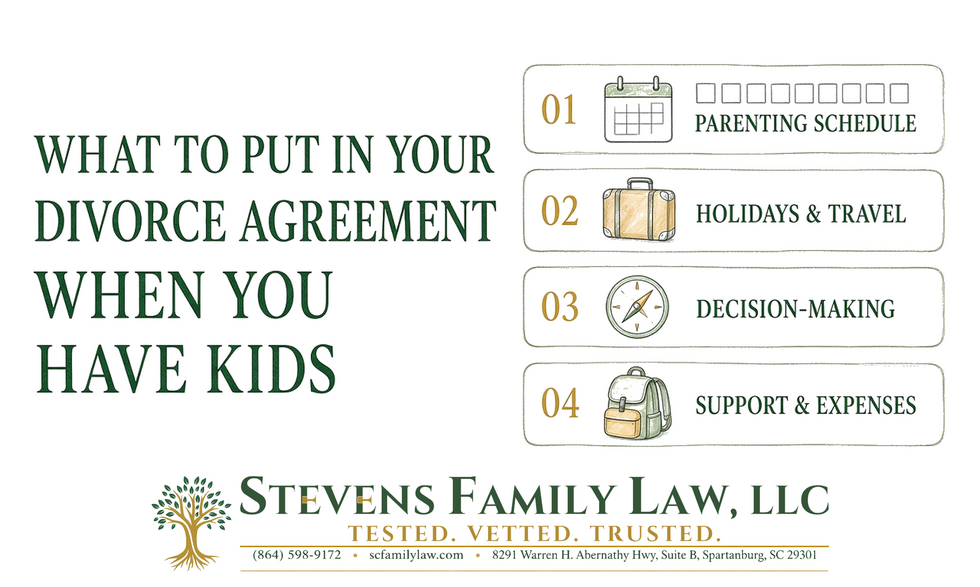
- A holiday schedule with dates and times. Not "alternating holidays," but who has Thanksgiving in even years, when Christmas Eve starts and ends, and where the exchange happens.
- Travel. How much notice before an out-of-state trip, what information gets shared, whether international travel needs written consent, and who keeps the child's passport.
- Communication. How the two of you will talk about the children, whether by text, email, or an app, and how quickly a reply is expected.
- Costs the support figure doesn't cover. Activities, uncovered medical and dental bills, school expenses, and how each is split and repaid.
- Phones and screens. When the child gets a phone, who pays for it, and whether the same rules apply in both homes.
- Moving. How much notice a parent must give before relocating, and what happens to the schedule if one parent moves.
- Resolving disagreements. Whether you'll go back to mediation before either of you files anything in court.
Support after 18 is an agreement question
South Carolina child support generally runs until a child turns 18, with an extension while the child is still in high school, capped at graduation or the end of the school year after the child turns 19, whichever is later. The statute also allows support past 18 "in accordance with a preexisting agreement or order." S.C. Code § 63-3-530(A)(17).
The practical lesson: if the two of you intend to share college costs or support a child after high school, say so in the agreement, and say it specifically. Which costs, what limits, what happens if the child takes a year off. An agreement that only says "the parties will contribute to college" leaves the hardest questions for later.
Specific beats friendly
The most common mistake isn't leaving something out. It's writing a term so general that it only works while everyone is getting along. "Reasonable" and "liberal" sound generous in mediation. Two years later, after a new partner or a new job, they mean whatever each parent needs them to mean.
A specific agreement isn't a sign of distrust. It protects the relationship you're trying to preserve, because it gives both of you an answer that doesn't require a fresh negotiation every time a holiday comes around. If your agreement is being worked out in mediation, bring this list with you.
What this means for you
Before you sign, read the parenting terms as if it were three years from now, on the worst day you and the other parent will ever have. If a term could be read two ways, eventually it will be. Fix it now, while you're both at the table. Some of what you agree to can be changed later and some is far harder to undo; our post on what parts of a South Carolina divorce decree can be changed explains the difference.
Stevens Family Law, LLC is devoted exclusively to family law, and our attorneys handle divorce, custody, and mediation matters in Family Courts across South Carolina. If you're heading into mediation or reviewing a proposed agreement, we can help you find the gaps before they turn into disputes. Call us at (864) 598-9172, or request a consultation.
This article is general information, not legal advice, and reading it does not create an attorney-client relationship. Every family's agreement should fit its own circumstances, and outcomes vary from case to case.



Comments
There are no comments for this post. Be the first and Add your Comment below.
Leave a Comment