
The payment was due on the first. It's now the fifteenth. You've texted and called, and what you got back was silence or a story. Meanwhile the daycare bill, the rent, and the kids' shoes aren't waiting.
Child support in South Carolina is a court order, not a favor. When it stops, you have real tools to get it moving again, and most of them don't require you to win an argument with your ex.
Start with how the support is paid
How the money is supposed to move decides which tools are already in place. Many South Carolina orders provide for income withholding, which means support comes straight out of the paying parent's paycheck. Under state law, most support orders entered or changed since the 1990s are subject to immediate withholding unless the judge found a good reason not to require it, or the parents agreed in writing to another arrangement.
Pull out your order and look. If support was withheld from wages and it suddenly stopped, the most common cause is a job change. The withholding has to follow the parent to the new employer. If payments run through the Family Court's records, the Clerk of Court already knows about every missed payment. If your ex was supposed to pay you directly, the only record is yours, so start keeping it today.
What the Clerk of Court can do
Missed payments that run through the court don't go unnoticed. Once a parent is behind by at least one month's support, South Carolina law calls that a delinquency, and the Clerk of Court must prepare and serve a notice of delinquency on the paying parent. That notice warns that wage withholding will begin and that the unpaid amount can be recorded as a judgment lien against the parent's property. If your ex was paying you directly and you want withholding to start, you can verify the notice yourself, and the clerk serves it.
The paying parent then has 10 days to ask the court to stop the process, and the grounds for doing that are narrow. If nobody objects, the withholding notice goes to the employer and the arrearage — the total amount past due — can be recorded. A recorded arrearage has the same effect as a judgment, and it is not wiped out by bankruptcy.
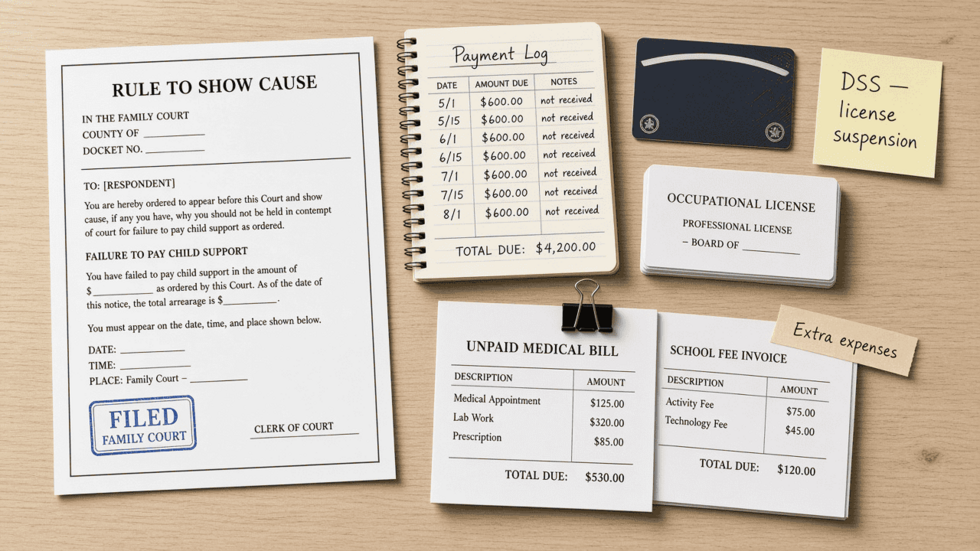
Under Family Court rules, the clerk can also issue a rule to show cause in a support arrearage case — more on what that is below. When the clerk does, the law requires notice of the hearing to be mailed to you at least five days ahead. Go to that hearing.
A rule to show cause, and what contempt can mean
When the automatic steps don't fix the problem, the main court tool is a contempt action. It starts with a rule to show cause: an order requiring your ex to come to court and explain why they should not be held in contempt. We walked through that process in our post on how to enforce a divorce decree, and it works the same way for unpaid support.
Contempt requires willful refusal to obey the order. A parent who truly can't pay, and can prove it, stands in a different place from one who can pay and won't. If the court finds contempt, South Carolina law allows up to one year in a local detention facility, a fine of up to $1,500, up to 300 hours of public works, or a combination. Those are maximums, not typical outcomes. In most support cases, what matters more is that the court sets terms for paying what is owed.
Medical bills, school costs, and other expenses the order assigns outside the regular monthly payment have their own streamlined route. You can file an authorized affidavit form with the bills and your written request for payment, and the court issues a rule to show cause. Once you prove your claim, the burden shifts to the other parent to establish a defense. You have to attend that hearing yourself.
License suspension and DSS enforcement
The South Carolina Department of Social Services, through its Child Support Services Division, enforces support orders for parents who apply. In cases DSS enforces, state law requires that a parent who falls out of compliance lose their licenses — driver's licenses, professional and occupational licenses, hunting and fishing licenses, and watercraft registrations — unless, within 45 days of notice, the parent pays the arrearage or signs a payment agreement with DSS.
DSS also lists tax refund intercepts, bank account and insurance liens, credit bureau reporting, and passport denial among its remedies, each with its own dollar thresholds. Whether to apply to DSS, file in Family Court on your own, or do both depends on your order and your goals. That's worth sorting out with a lawyer before you choose.
What not to do
Don't keep the children from their other parent. Support and parenting time are separate obligations under your order, and holding back visits because the money stopped can put you on the wrong end of a contempt motion of your own.
Don't make side deals. If your ex offers to "catch up next month" or pay less for a while, an informal promise doesn't change the court's order, and it can muddy the record later. Keep records instead: what was due, when, what came in, how it was paid, and every written message about it.
What this means for you
Act early. Arrears grow every month, and a parent who is three months behind is a much easier problem than one who is three years behind.
And be honest with yourself about why the payments stopped. If your ex's income really has dropped, the right answer may be a modification rather than contempt, and the court can sort out which. If they quit or cut their hours to avoid paying, the court can look past that. Our post on how child support is calculated in South Carolina explains how income is counted in the first place.
Stevens Family Law, LLC is devoted exclusively to family law, and our attorneys handle child support enforcement matters in Family Courts across South Carolina. A support order only helps your children if it's paid, and we can help you decide whether the clerk's process, DSS, a contempt action, or some combination fits your situation. You can reach us at (864) 598-9172, or request a consultation.
This article is general information, not legal advice, and reading it does not create an attorney-client relationship. Enforcement options depend on how your order is written and how support is paid, and outcomes vary from case to case.



Comments
There are no comments for this post. Be the first and Add your Comment below.
Leave a Comment