
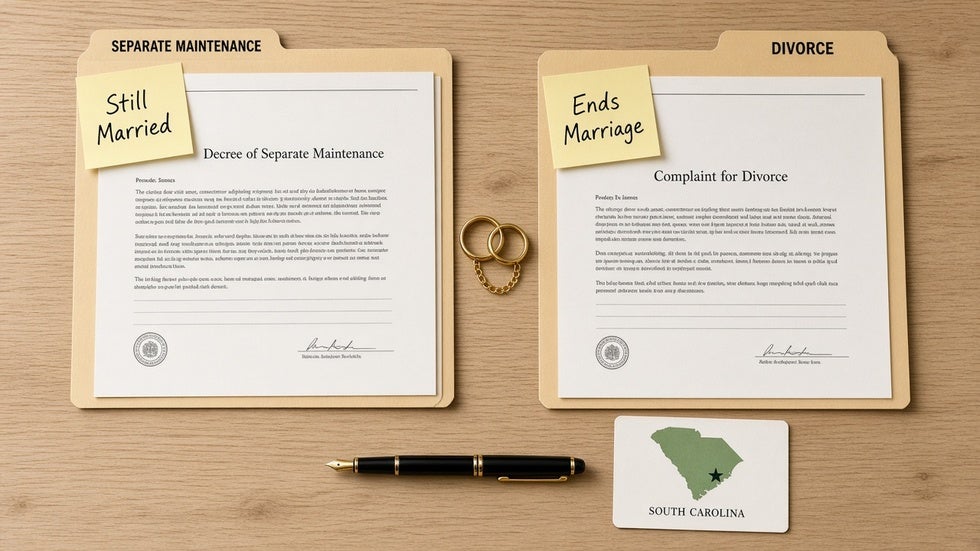
A decree of separate maintenance is South Carolina's formal path when spouses live apart and need court orders, but are not ready—or do not want—to divorce yet. People often call this “legal separation.” The decree can address alimony or support, child custody and parenting time, child support, and property or debt issues while the marriage remains intact.
Stevens Family Law advises clients statewide on whether separate maintenance fits their goals, how it differs from divorce, and how to prepare a case for temporary relief or a final decree. Our practice is based in Spartanburg and focused on South Carolina family law.
Decree of separate maintenance vs. divorce in South Carolina
Under a decree of separate maintenance, you remain married. The Family Court can still enter enforceable orders about money, children, and property, but there is no divorce judgment ending the marriage. That is the core difference from a divorce or separation case that seeks a final divorce.
Some clients choose separate maintenance for personal or religious reasons, to keep certain benefits timing intact for a period, or to put clear rules in place while they decide whether divorce is next. Others need the structure of court orders without filing for divorce yet. The right path depends on your facts and goals—not on a one-size label.
What a separate maintenance decree can cover
A separate maintenance action can address many of the same practical issues as other Family Court cases. That often includes child custody and parenting time, child support, and alimony or spousal support. It can also cover use of the marital home, certain property and debt issues, and related terms the court finds appropriate.
Because the marriage continues, planning still matters. What you agree to—or what the court orders—can shape day-to-day life now and affect later divorce or modification issues. Clear drafting and a complete record help either way.
Who should consider legal separation in South Carolina
Legal separation (separate maintenance) may fit if you need enforceable rules while living apart, but you are not ready to end the marriage. It can also fit high-conflict situations where informal “trial separations” keep failing because there is no order to enforce.
Parents in contested parenting disputes, spouses who need support terms in place, and families dealing with interstate complications should get advice early. Separate maintenance is still Family Court litigation when the issues are contested. If your situation is already high-conflict, treat it with the same seriousness as other contested family-law work.
How the process typically works
Most cases start with a Family Court filing that asks for separate maintenance and related relief. Temporary hearings may address short-term support, parenting schedules, or use of the home. Many cases resolve through negotiation or mediation; others require a hearing or trial on disputed terms.
A final decree of separate maintenance sets the ongoing rules while you remain married. Some people later convert that posture into a divorce case when they are ready. Process and timing vary by county, judge, and facts, so local counsel matters.
Contested separate maintenance and enforcement
When spouses disagree on custody, support, or property terms, separate maintenance can become a contested case. Evidence, temporary strategy, and trial preparation matter the same way they do in other contested Family Court matters.
Once a decree or temporary order is in place, both parties are bound by it. If parenting time, support, or other terms are ignored, South Carolina Family Court allows enforcement through a Rule to Show Cause / contempt action.
If you are considering a decree of separate maintenance or need advice on legal separation versus divorce in South Carolina, contact Stevens Family Law to discuss your situation.