
Someone has given you a number. A coworker who went through this two years ago, an online calculator, or your spouse, who says the number with a great deal of confidence.
Any of them can be wrong, and the reason is almost always the same: child support in South Carolina is not a percentage of one person's paycheck. It is a calculation that starts with both parents' incomes and works down through a series of adjustments, and a number produced without all of those inputs is a guess wearing a decimal point.
Here is what actually goes into the worksheet.
The starting point is both parents' gross income
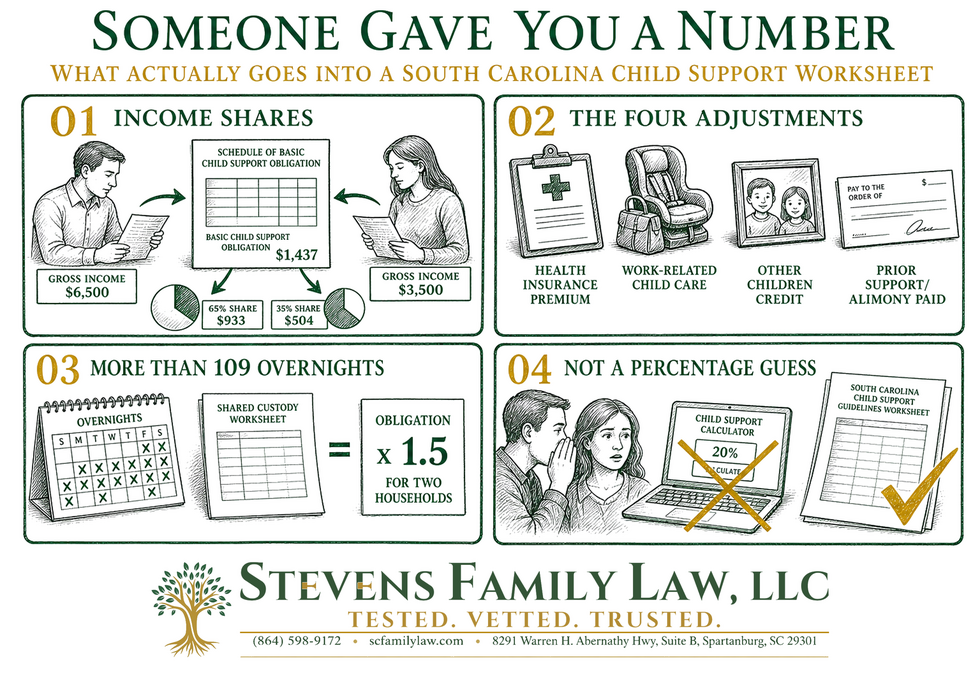
South Carolina uses what is called an income shares model. The premise is stated plainly in the guidelines: the children should receive the same proportion of parental income they would have received if the parents lived together. So the court adds both parents' gross monthly incomes together, finds the basic support obligation for that combined figure on a published schedule, and then divides it between the parents in proportion to what each one earns.
Gross income is broader than a paycheck. It includes salaries, wages, commissions, royalties, bonuses, rents less ordinary business expenses, dividends, severance, pensions, interest, trust income, annuities, capital gains, Social Security benefits other than SSI, workers' compensation, unemployment benefits, veterans' benefits, and alimony received. The court may also look at assets that could be producing income and are not.
It does not include means-tested public assistance such as TANF, SSI, food stamps, or general assistance. It does not include income belonging to other people in the household – a new spouse's salary is not part of the calculation. And it does not include in-kind income.
Four adjustments come next
Before the schedule figure becomes anyone's obligation, the worksheet accounts for a short list of real costs:
- The cost of the children's health insurance, counting only the portion the parent actually pays
- Work-related child care, figured net of the federal and state income tax credit
- A credit for other natural or adopted children living in that parent's home, calculated at 75 percent of what those children's basic support would be – a credit that does not extend to stepchildren unless a court order creates the responsibility
- Alimony or child support actually being paid for someone else under an existing court order, which comes off gross income
Uninsured medical costs are handled separately. The schedule already assumes $250 per child per year in out-of-pocket medical expense. Reasonable costs above that are divided between the parents in proportion to their share of combined income, which is why the orthodontist bill is usually not a fight about who pays but about what share.
Overnights change the math
The single largest swing in most ordinary cases is the parenting schedule.
If each parent has court-ordered overnight visitation with the children for more than 109 overnights a year — 30 percent of the year — the case runs on the shared custody worksheet instead of the standard one. The basic obligation is multiplied by 1.5 to account for the duplicated cost of maintaining two functioning households, and the calculation proceeds from there.
That threshold is worth understanding before you agree to a parenting schedule. It is not a reason to bargain for overnights you do not want, and courts see that for what it is. But a schedule negotiated with no idea that 110 overnights is a line in the guidelines is a schedule negotiated half-blind.
Split custody — where there are two or more children and each parent has physical custody of at least one — works differently again. The court calculates a theoretical obligation for the children in each parent's care, offsets the two, and the parent with the larger figure pays the difference.
The guidelines are a presumption, not a ceiling
The amount produced by the guidelines is the amount to be awarded. That is the rule, and it is a rebuttable presumption rather than a suggestion. A court that orders support varying significantly from the guideline figure has to make specific written findings explaining why, and the guidelines themselves say deviation should be the exception rather than the rule. There are twelve enumerated factors that can support one.
The schedule has edges. It covers combined monthly gross income from $750 up to $40,000 — that is $480,000 a year. Above that ceiling, courts determine support case by case. Below $750, the same, with an ordinary minimum of $100 a month. There is also a self-support reserve of $1,010.50 per month, which is what keeps a low-earning parent's obligation from consuming the income they need to live on; when the numbers fall into the shaded portion of the schedule, support is calculated on the paying parent's income alone.
Those figures come from the 2024 South Carolina Child Support Guidelines, which took effect January 1, 2024. They are revised periodically. Any figure in this post should be checked against the current guidelines before you rely on it.
If a parent quits, or suddenly earns less
Courts have seen this before.
Where a parent is voluntarily unemployed or underemployed, support may be calculated on potential income rather than actual income. The guidelines direct the court to look at that parent's assets, residence, employment and earnings history, job skills, education, literacy, age, health, criminal record and other employment barriers, and record of actually seeking work — along with the local job market and what similar work pays in the community.
It is a real inquiry, not a rubber stamp, and it cuts both ways. A parent laid off in a genuine downturn is in a different position from a parent who resigned the month before the hearing. The guidelines also make clear that a determination of willful unemployment is not to be made where incarceration is what prevents the parent from working.
How long it lasts
Under S.C. Code § 63-3-530(A)(17), a child support order runs until the child turns 18, marries, or becomes self-supporting as determined by the court — whichever comes first. It continues past 18 if the child is still enrolled in and attending high school, through graduation or the end of the school year after the child turns 19, whichever is later.
What this means for you
Run the calculation before you agree to anything.
Most of the child support disputes that turn ugly did not start as disputes about money. They started when one parent agreed to a number they had not seen calculated, discovered a year later what the worksheet actually produced, and concluded they had been taken advantage of. Sometimes they had been. More often, nobody ran the numbers.
The worksheet is not a mystery and it is not discretionary in the way people assume. Get your income figures and your spouse's in front of someone who works with the guidelines regularly, look at what the schedule produces, and then decide what to do about it. A number you understand is a number you can live with — and, if it is wrong, a number you can challenge.
Stevens Family Law, LLC represents clients in complex and high net worth family law matters across South Carolina. If you have questions about how child support would be calculated in your situation, we would be glad to talk with you.
This article is general information, not legal advice, and reading it does not create an attorney-client relationship. The guideline figures described here are current as of the 2024 South Carolina Child Support Guidelines and are revised periodically.



Comments
There are no comments for this post. Be the first and Add your Comment below.
Leave a Comment