
You have been sleeping in the guest room since February. You have a date circled on the calendar — one year from the night the arguing finally stopped — and you have been counting toward it.
Here is the part nobody told you: that clock may never have started.
South Carolina's no-fault ground for divorce requires that a husband and wife have “lived separate and apart without cohabitation for a period of one year.” That language comes from S.C. Code § 20-3-10(5), and every word in it does work. One year. Separate and apart. Without cohabitation.
There is no form you file to start the year. There is no document that makes you separated. You are separated when you are actually living apart — and that is exactly where people lose months they thought they had banked.
South Carolina recognizes five grounds for divorce
Section 20-3-10 lists them, and that list is closed:
- Adultery
- Desertion for a period of one year
- Physical cruelty
- Habitual drunkenness, which the statute construes to include habitual drunkenness caused by the use of any narcotic drug
- Living separate and apart without cohabitation for a period of one year
The first four are fault grounds. Someone has to prove something, and proving it changes the shape of the case. The fifth asks only that time has passed and that you spent it apart. That is why most South Carolina divorces are built on it, and why the one-year question is the first one people ask.
“Separate and apart” means two addresses
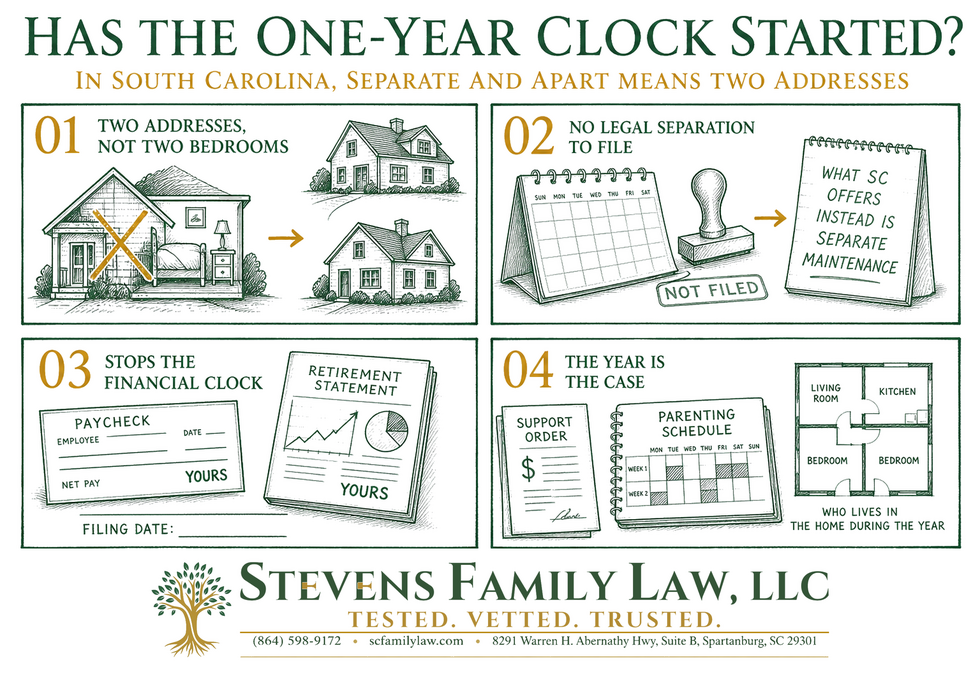
The statute does not say separate bedrooms. It does not say you stopped speaking, or that one of you moved to the basement, or that you agreed in writing that the marriage was over. It says living separate and apart without cohabitation, and the only safe reading is the literal one: two residences.
This is the single most common way people arrive at a divorce consultation with less time on the clock than they believed. A couple stays under one roof for the children, or for the mortgage, or because neither one can afford a second rent payment. They are miserable and living parallel lives, and they are not separated in the way § 20-3-10(5) means.
The related question — whether a night back together, or a weekend trip taken to see if things could be repaired, resets the year — has real case law behind it and turns on facts. It is not a question to answer for yourself and find out later.
There is no “legal separation” you can file for here
People call the office asking to file for legal separation. South Carolina does not offer the thing they are picturing: a court order that changes your marital status while you wait.
What South Carolina does offer is an action for separate maintenance and support. The Family Court's jurisdiction statute, S.C. Code § 63-3-530(A)(1), places actions for “separate support and maintenance” alongside divorce and other marital litigation. It is a real lawsuit with a real order at the end of it. It simply does not end the marriage.
What that order can do is most of what you actually need decided:
It can set spousal support and child support so that the household bills get paid by someone other than whoever is most afraid of the consequences. It can establish custody and a parenting schedule. It can address who lives in the marital home while all of this is pending.
And it stops the financial clock. Under S.C. Code § 20-3-630, marital property is what the parties acquired during the marriage and own as of the date marital litigation is filed. Property acquired after a temporary order, after a signed written property or marital settlement agreement, or after a permanent order of separate maintenance and support is nonmarital. In plain terms: every paycheck you deposit and every retirement contribution you make after that line is drawn is yours.
If you and your spouse are going to live apart for a year, that line matters more than almost anything else you will decide during it.
You also have to meet the residency requirement
Section 20-3-30 sets it out. To file for divorce in South Carolina, you must have lived in this state for at least one year before the action is commenced. If you are the nonresident and your spouse is here, your spouse must have lived here that long. If both of you are South Carolina residents when the action is commenced, the filing spouse needs only three months.
Someone who moved here after the marriage came apart should check this date before doing anything else.
Once the year is up, the case moves faster than you think
South Carolina has a built-in waiting period. Section 20-3-80 says no reference may be had before two months after the complaint is filed, and no final decree may be granted before three months after filing.
There is an exception, and it covers exactly the case we are talking about. Where the ground is desertion or one year's separation, the hearing may be held and the decree issued once responsive pleadings have been filed or the respondent has been adjudged in default, whichever comes first.
So the year of separation happens before you file. The case itself does not add another three months on top of it. Expect the court to make an earnest effort toward reconciliation along the way — § 20-3-90 requires it — but a properly prepared one-year separation case is not a slow case.
What this means for you
The year is not a waiting room.
That is the mistake, and it is expensive. People decide they will “deal with it after the year,” and they spend twelve months with no support order, no written parenting schedule, a mortgage paid by whoever blinks first, and joint finances that keep commingling. Then they come in at month eleven and discover that support does not run backward to cover the year they went without it, and that the informal schedule the other parent has settled into is now the schedule the children are used to.
The year is the case. What gets decided during it — support, the children's time, the roof over each of your heads, and the date your finances stop being joint — is most of what you will live with afterward. The divorce at the end is the paperwork.
If you are counting toward a date, the useful question is not how many months are left. It is whether the clock is running at all, and what should already be in place before it stops.
Stevens Family Law, LLC represents clients in complex and high net worth family law matters across South Carolina. If you have questions about separation, the one-year ground, or an action for separate maintenance and support, we would be glad to talk with you. You are welcome to contact our office at (864) 598-9172 or by using the contact form on this page.
This article is general information, not legal advice, and reading it does not create an attorney-client relationship. Separation and divorce timing is fact-specific, and the dates that matter in your case may not be the ones you have been counting.



Comments
There are no comments for this post. Be the first and Add your Comment below.
Leave a Comment