
Maybe you want back the name you had before you married. Maybe you have carried a name for years that never felt like yours. Or maybe the reason is one you would rather not explain to anyone at all. Whatever the reason, the legal question is the same: how do you make a new name official in South Carolina?
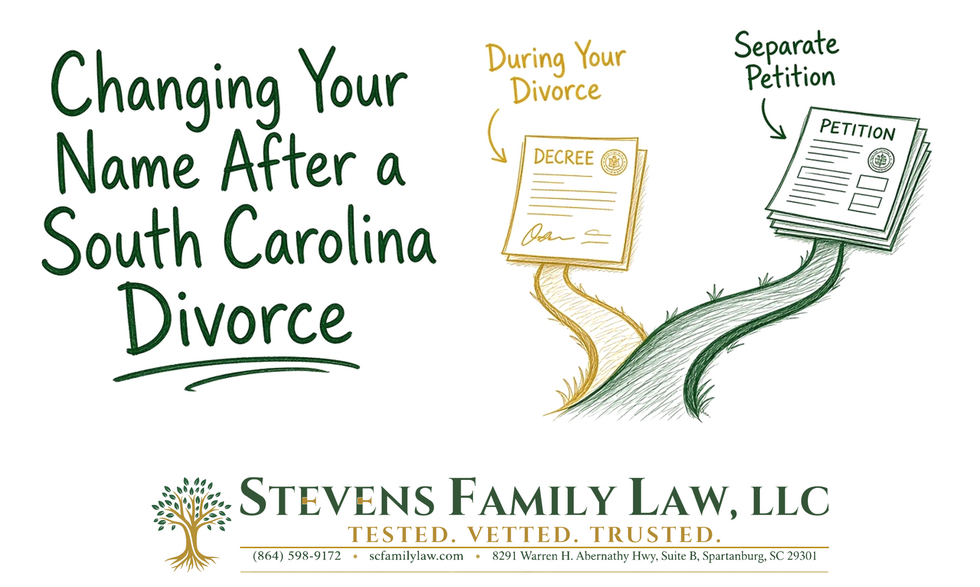
There are two routes, and the difference between them is mostly about timing. One is short and attached to a divorce. The other is a separate Family Court case with background checks and a hearing. Knowing which one you are on — and not missing the easy one — is most of the battle.
The easy route: during your divorce
If you are going through a divorce, the simplest time to change your name is inside that case. Section 20-3-180 of the South Carolina Code provides that "the court, upon the granting of final judgment of divorce or an order of separate maintenance, may allow a party to resume a former surname or the surname of a former spouse."
The name-change statute confirms that this path skips the heavier requirements. Section 15-49-20(J) says the general provisions "do not apply to a person who wishes to resume her maiden name as a result of a domestic action filed in family court," and that a judge "may authorize a name change" in another order, "including, but not limited to, an order for separate support and maintenance or a final divorce decree." That subsection is written about a maiden name, but § 20-3-180 itself speaks of "a party," so either spouse may ask.
The practical point is simple. Ask for it, and then make sure the final order actually says it. If you settle, put the name change in the agreement. When the decree arrives, read it for that sentence before you file it away.
The full route: a petition to the Family Court
At any other time, a name change is its own case. Under § 15-49-10(A), a person who has lived in South Carolina "for at least six months" may petition a Family Court judge, setting out "the reason for the change, his age, his place of residence and birth, and the name by which he desires to be known."
Section 15-49-20(A) then requires the petition to come with supporting paperwork, including:
- A fingerprint-based criminal background check from the State Law Enforcement Division (SLED).
- A screening statement from the Department of Social Services showing whether you are listed on its Central Registry of Child Abuse and Neglect.
- A screening statement from SLED on the sex offender registry.
- An affidavit saying whether you are under a court order to pay child support or alimony.
- An affidavit and proof that you have lived in South Carolina for at least six months.
The court may hold a hearing and require you to attend. Then, under § 15-49-20(C), the judge must "grant or refuse the name change as the judge considers proper, having a due regard to the true interest of the petitioner and protection of the public." That last phrase explains the background checks. The court is making sure a new name is not a way to escape a record or an obligation.
The statute also recognizes that some people change their names for safety. It allows the court to waive the six-month residency requirement for a petitioner who shows they are a victim of domestic violence, stalking, or other listed abuse and is in reasonable fear for their safety, and it allows the file to be sealed when safety warrants it. We wrote more generally about what stays private in a South Carolina Family Court case.
Missed the divorce window?
It happens often. The divorce was final years ago, nobody asked, and the decree is silent. In that situation, the simpler path tied to the divorce case is generally no longer available, and the petition route — background checks and all — is the one that applies. It takes longer, but it is a well-worn process.
Changing a child's name
A child's name is different, because it is not only one parent's decision. Under § 15-49-10(B), a parent may petition to change a minor child's name, but "the other parent" must be named as a party unless the court waives it, the court "shall appoint a guardian ad litem to represent the child," and the court grants the petition only "if it finds that it is in the best interest of the child."
So a parent who resumes a former name after divorce cannot simply change the children's names to match. The other parent gets a voice, the child gets a representative, and the court decides. If you are weighing this, the best-interest factors give a sense of how Family Court thinks about children's interests generally.
What this means for you
If you are in a divorce now and think you may want your former name back, decide before the case ends, and get it into the agreement or the decree. It costs almost nothing then and considerably more later.
If you are past that point, start the background checks early. They are the slowest part of the process. And once the order is signed, remember that it is the start of the paperwork, not the end. Social Security, the DMV, your passport, your employer, and your bank all have their own processes for updating your records.
Stevens Family Law, LLC is devoted exclusively to family law, and our attorneys handle divorce and related matters in Family Courts across South Carolina. A name change is one of the smaller decisions in a divorce, and one of the easiest to get right if it is raised at the right time. You can reach us at (864) 598-9172 or through our consultation form.
This article is general information, not legal advice, and reading it does not create an attorney-client relationship. Filing requirements and fees change from time to time, so confirm current requirements with the Family Court in your county before you file.



Comments
There are no comments for this post. Be the first and Add your Comment below.
Leave a Comment