
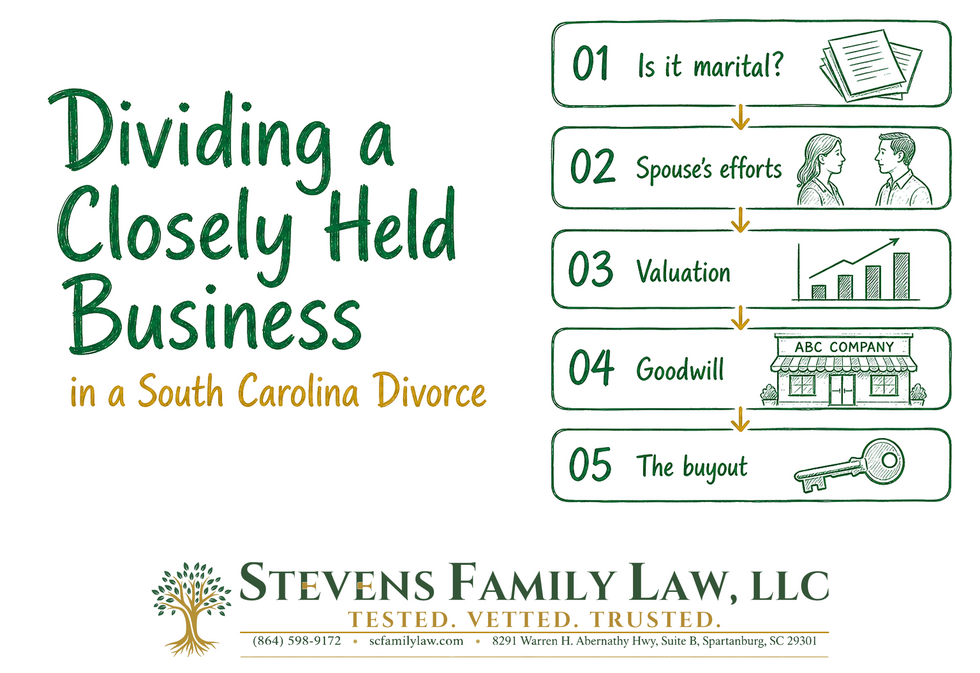
What South Carolina law actually does with the company you built: classification, valuation, goodwill, and how the other spouse is usually paid.
Clients who own a closely held business, or whose spouse does, often arrive at the first meeting with one of two assumptions. The owner assumes the company is off the table because it is in one name, or because it existed before the wedding. The non-owner assumes a divorce means half the shares, a seat in the boardroom, or a forced sale. Neither is how South Carolina family court actually works.
The court does not start by splitting the company down the middle. It starts by asking three questions, in order: is any of this marital property, what is it worth, and how should that value be apportioned so one spouse can keep operating the business and the other can leave with an equitable share.
Is the business marital property?
South Carolina defines marital property broadly. With limited exceptions, marital property is all real and personal property acquired by either party during the marriage and owned as of the date marital litigation is filed, regardless of whose name is on the operating agreement, the stock ledger, or the deed. A business started during the marriage is usually marital property, even if only one spouse ever drew a paycheck from it.
The exceptions are specific. Property acquired by inheritance or gift from someone other than the spouse, property acquired before the marriage, property acquired in exchange for nonmarital property, and property excluded by a valid written contract (including a prenuptial agreement) are nonmarital. The court does not have authority to divide nonmarital property.
A prenuptial agreement that addresses the business is the cleanest way to keep it off the table. Under South Carolina law, that kind of written contract is presumptively fair and equitable if it was signed voluntarily, both parties had their own lawyers, and there was full financial disclosure of income, debts, and assets. A postnuptial agreement can do similar work after the wedding, though it is scrutinized at least as carefully.
What if the business existed before the marriage?
A premarital business does not automatically become marital just because the marriage lasted a long time. Title in one spouse's name is not the end of the analysis, either.
Two doctrines do most of the work here.
Transmutation. Nonmarital property can become marital if the parties treated it, during the marriage, as common property of the marriage. That is a question of intent, and the spouse claiming transmutation has to produce objective evidence of it. Putting the other spouse on the ownership documents, commingling business and marital funds, or using marital money to build equity in the company can all be evidence. Using the business to support the household, without more, is not enough.
The other spouse's efforts. Even when the business itself remains nonmarital, South Carolina law treats as marital any increase in value that resulted, directly or indirectly, from the efforts of the other spouse during the marriage. Unpaid bookkeeping, customer development, covering the household so the owner could grow the company, or marital funds reinvested into the business are the kinds of facts that put appreciation in play. Passive growth that is simply the market doing what markets do is a different question, and it is often still nonmarital.
What this means practically: the owner who kept the books separate, paid the other spouse a real wage for real work, and never treated the company as "ours" is in a different position than the owner who ran payroll out of the joint checking account and had a spouse managing the back office for years without a W-2. Tracing records from before the marriage, and from during it, is what makes that distinction provable instead of a story.
How the court values a closely held company
Once the marital portion is identified, it has to be valued. South Carolina law presumptively values marital property as of the date of filing. The parties can share in later appreciation or depreciation, but the spouse who wants a different date has to prove why the filing date should not control.
Closely held companies are not publicly traded, so there is no ticker price. Each side typically retains a valuation expert. Those opinions can diverge sharply, because the experts may disagree about the valuation method, the discounts, the date, and, most often, goodwill.
Family courts look at the evidence in front of them. A detailed report that is tied to the company's actual operations, customers, and financials carries more weight than a number that ignores how the business actually makes money.
Goodwill: the part of the value that is not on the balance sheet
Much of a closely held company's worth may be goodwill, the value beyond hard assets. South Carolina's appellate courts have drawn a line that matters in almost every one of these cases.
Enterprise goodwill attaches to the business itself. It is the going-concern value that would transfer to a willing buyer: the name, the systems, the customer relationships that would survive if the current owner walked away. Enterprise goodwill is marital property and is subject to equitable division.
Personal goodwill attaches to the individual. It is the portion of earning capacity that comes from one person's reputation, skill, and relationships, the clients who would follow that person out the door. Personal goodwill is not marital property. It is treated as future earning capacity, not as an asset to be split.
The essential question is practical: can the business generate revenue from continued patronage without the current owner's participation? A manufacturing or distribution company with systems, employees, and a brand often has substantial enterprise goodwill. A professional practice that lives on one person's license, name, and book of business often has substantial personal goodwill. Many closely held companies have some of both. That mix is a fact question, and it is one of the main reasons these cases turn on expert testimony.
A related issue is the marketability discount, a reduction some valuators apply because shares of a closely held company are hard to sell. South Carolina has no bright-line rule requiring or forbidding that discount. When the owner-spouse is going to keep the company, the court may decline to reduce the value for a sale that is not actually happening.
How the value actually changes hands
Equitable is not the same as equal, and it is almost never a joint operating agreement going forward. South Carolina courts divide the marital estate under a list of statutory factors. They also have a strong practical preference: one spouse keeps the business, and the other is made whole with other assets or a buyout.
That can look like a larger share of the house, retirement accounts, or investment accounts on the non-owner's side. It can look like a cash payment, sometimes over time, with interest. What it rarely looks like is two former spouses remaining co-owners of a going concern. If the owner cannot pay a lump sum, the structure of any payout (how long, what security, what interest) becomes part of the case.
Expect a current Financial Declaration. Rule 20 of the South Carolina Rules of Family Court requires one in cases where a party's financial condition is relevant, and the figures have to be updated as circumstances change. For a business owner, that means real books: tax returns, K-1s, profit-and-loss statements, balance sheets, accounts receivable, debt, and a clear picture of what is business and what is personal. An inflated appraisal on one side, or a set of books that cannot be reconciled on the other, is how these cases get expensive.
What to do if a divorce is on the horizon
If you are the owner: do not drain the company, do not mix personal and business spending any more than you already have, and do not assume that "it's in my name" answers the question. Gather the organizing documents, the cap table, the last several years of tax returns, and any prenuptial, postnuptial, or buy-sell agreement. If there is a buy-sell, it may speak to price and terms, but it does not automatically bind the family court.
If you are the non-owner: do not assume you have no claim because you never sat in the office, and do not assume you are entitled to half the shares. What you did during the marriage, paid or unpaid, and how the family's money moved through the company are the facts that matter. Save what you have. Do not guess at the value.
Either way, a consultation early is worth more than one after the temporary hearing. Temporary orders can affect cash flow, control, and the documents the other side is required to produce, and those early numbers have a way of setting the tone for the rest of the case.
Talk With Our Team
A closely held business is often both the family's largest asset and one spouse's livelihood. Those two facts pull in opposite directions, and South Carolina law is built to deal with that tension, if the classification, the valuation, and the buyout are handled in the right order.
Stevens Family Law, LLC represents clients throughout South Carolina in high-asset divorce, business-owner divorce, and related family law matters. If you or your spouse owns a closely held company and a divorce is in view, contact our office at (864) 598-9172 or visit www.SCFamilyLaw.com to schedule a consultation.
This article is provided for general information only and is not legal advice. It does not create an attorney-client relationship. Outcomes in family law cases depend on the specific facts of each case, and the law described here is current as of September 2026.



Comments
There are no comments for this post. Be the first and Add your Comment below.
Leave a Comment