
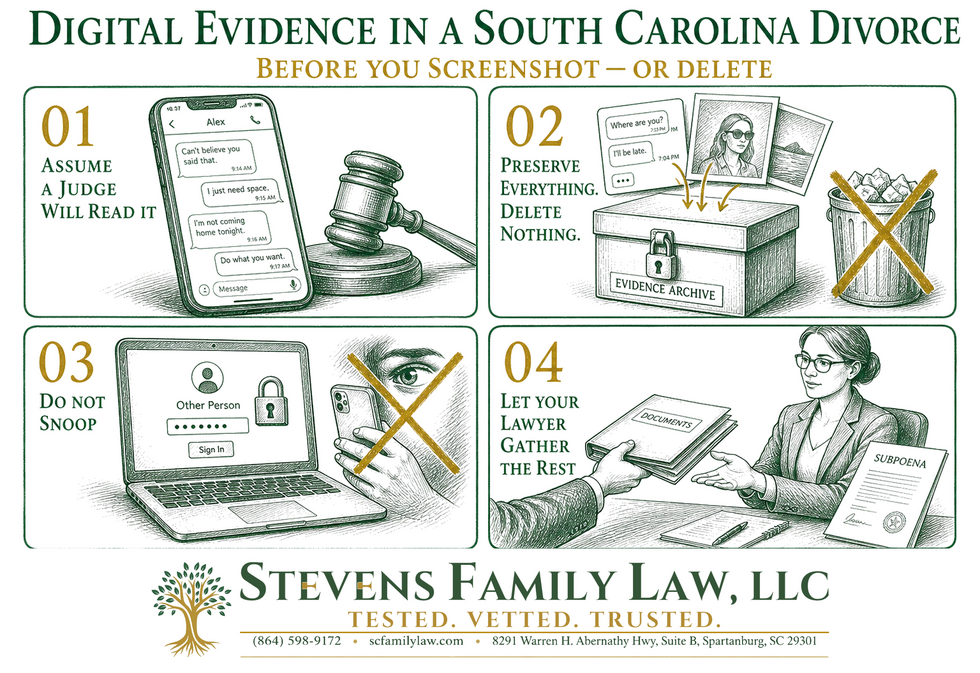
Twenty years ago, a contested divorce turned on documents and testimony. Today, it often turns on a phone. Text messages, emails, group chats, location history, banking apps, and social media posts create a detailed, time-stamped record of what people did and what they were thinking when they did it — and that record does not forget, does not get nervous on the witness stand, and does not change its story.
That reality cuts both ways. The same evidence that establishes hidden income or a pattern of hostile co-parenting can just as easily undercut the person who went looking for it. In South Carolina, some of the most tempting ways to gather that evidence are felonies. Here is what clients should understand before they start screenshotting — or start deleting.
Digital Records Are Usually the Most Reliable Evidence in the File
Family court judges often hear two very different accounts of the same marriage. Things that were written without an audience in mind, such as a text sent in the middle of an argument, an email discussing a business account, a Venmo memo line, etc., can break that tie.
Courts tend to treat contemporaneous communications, written before anyone was thinking about litigation, as more reliable than testimony reconstructed months later through the filter of a lawsuit. That is exactly why a single message can carry more weight than an hour of direct examination.
Where It Shows Up in Financial Disputes
Digital evidence can be especially helpful when it comes to financial issues. Emails and account records can reveal income that never appeared on a Financial Declaration, money spent on a third party, transfers to family members, undisclosed business interests, or crypto accounts.
Social media can be the cheapest impeachment tool available. A party who reports minimal income while posting from a new boat, a beach house, or a resort has created a problem that is difficult, if not impossible, to explain away.
Where It Shows Up in Custody Cases
In a custody case, South Carolina courts consider the best interests of the child, and that inquiry includes each parent's judgment, stability, and willingness to support the child's relationship with the other parent.
Text and email threads between parents are close to a transcript of the parties' co-parenting relationship. Threatening or degrading messages, repeated schedule violations, and attempts to interfere with the other parent's time are all documented in writing. The opposite can also be true: a parent who communicates calmly, keeps the child out of adult conflict, and accommodates reasonable requests has built a strong record without trying.
Social Media: Assume a Judge Will Read It
Assume that everything you post will be printed, blown up, and handed to the judge with the least flattering interpretation attached. Photos, comments, check-ins, tagged posts, and even posts by friends can end up in evidence.
A parent who describes a demanding work schedule and constant caregiving is vulnerable if the timeline shows something else. Posts involving alcohol, new relationships, or angry commentary about the other parent are routinely used in custody litigation.
Privacy settings are not protection — most of this material arrives in my office because a mutual friend forwarded it. The safest practice during a pending case is to stop posting. Not scrub — stop. (More on that distinction below)
Recording Conversations: Legal in South Carolina, With Real Traps
South Carolina is a one-party consent state. A person who is a party to a conversation may generally record it without telling anyone else. In other words, if you are on the call, you can usually record the call, provided everyone is in South Carolina. However, even where state law permits a recording, the federal Wiretap Act's one-party consent provision does not apply where the recording is made for the purpose of committing a criminal or tortious act. A recording that is lawful in South Carolina can still generate federal liability, including statutory damages.
Further, recording a conversation you are not part of is a different matter entirely. Unlawful interception is a felony under South Carolina law and punishable by up to five years in jail, and it also creates a civil cause of action with liquidated damages of $500 per day of violation or $25,000, whichever is greater. Also, using or disclosing a communication that you know was illegally intercepted is a separate violation — so handing an unlawful recording to your lawyer creates new exposure rather than resolving the old one.
Parents sometimes ask about recording a child's calls with the other parent. In State v. Whitner, our Supreme Court adopted a limited "vicarious consent" doctrine allowing a parent with a good-faith, objectively reasonable basis to believe it is necessary and in the child's best interest to consent on the child's behalf. That case involved a child's disclosure of sexual abuse. It is not authority for recording a child's calls to gather custody ammunition, and it should be viewed as a narrow exception rather than a strategy.
Where Self-Help Snooping Crosses the Line
This is the section more people should read before their consultation with an attorney.
Logging into a spouse's email, guessing a password, resetting security questions, or getting into a phone or cloud account without permission can violate the federal Stored Communications Act (18 U.S.C. § 2701), the Computer Fraud and Abuse Act (18 U.S.C. § 1030), and South Carolina's Computer Crime Act (S.C. Code Ann. § 16-16-10 et seq.).
South Carolina has a well-known decision in this area, and it is widely misread. In Jennings v. Jennings, a divorce case, a relative of the wife guessed the answers to the husband's security questions, read his Yahoo! email, and gave copies to the wife's attorney. Our Supreme Court held that the emails he had already opened and left on the server were not in "electronic storage" under the Stored Communications Act, so that particular federal claim failed. The justices agreed on the outcome but split on the reasoning.
It is important to note that Jennings does not hold that reading your spouse's email is lawful in South Carolina. It resolved one claim under one federal statute as to already-opened messages. It says nothing about the Computer Fraud and Abuse Act, the South Carolina Computer Crime Act, unopened messages, or invasion of privacy. Anyone relying on it as a “green light” is reading a narrow statutory holding as a broad permission slip.
There is also a practical dimension. Illegally obtained evidence often cannot be used, may have to be disclosed, and can hand the other side a counterclaim and a credibility argument. Attorneys can explain what the law permits, but they cannot help design an operation that violates it — and any lawyer who would is creating problems for both of you.
Trackers and Monitoring Software
South Carolina does not currently have a statute specifically criminalizing placing a GPS tracker on another person's vehicle. Bills to create that offense have been introduced repeatedly, but none have been enacted as of this writing.
That is not the same as safe. A sustained course of tracking or surveillance can support charges of harassment or stalking under South Carolina law, and it can support a restraining order in family court regardless of who holds the title to the car.
Monitoring software is far more dangerous. So-called "stalker ware" that captures texts, calls, or messages as they are sent intercepts communications, which puts it squarely within both the South Carolina and federal wiretap statutes. The fact that a product is sold commercially and marketed to worried spouses does not make installing it lawful.
Do Not Delete Anything
Once litigation is filed or reasonably anticipated, the impulse to “clean up” is the single most damaging thing a client can act on.
South Carolina does not recognize an independent tort for spoliation of evidence, but that is small comfort. Courts may draw an adverse inference that destroyed evidence would have been unfavorable to the party who destroyed it, and destruction can support discovery sanctions. Deleting messages converts a bad fact into a credibility problem, and credibility problems typically bleed into every other issue in family law cases.
This applies to settings, not just to deliberate deletions. Turn off disappearing messages and auto-delete. Do not factory reset a phone. Do not deactivate accounts. If you are not sure whether something matters, ask before you touch it.
Getting Digital Evidence the Right Way
The lawful routes are less dramatic but far more useful, because what they produce is actually admissible in court.
Since 2017, discovery in South Carolina Family Court has been available as a matter of course once an action is filed, rather than requiring a separate order. That means interrogatories, requests for production, requests to admit, depositions, and subpoenas to third parties — with the notice requirements of Rule 45, SCRCP strictly observed, can be and are often used to obtain information and evidence.
One important limitation: the Stored Communications Act generally prohibits providers like Google and Meta from disclosing the contents of communications in response to a civil subpoena. In practice, content comes from the party, not the platform — through requests for production, court-ordered account downloads, a consent authorization, or an agreed forensic examination protocol.
Authentication and Context
Getting information into evidence is usually not the hard part. South Carolina's appellate courts have observed that the authentication standard "is not high" — testimony from someone with knowledge of the exchange, or distinctive characteristics in the message itself, is generally enough.
The real fight is the weight that the court gives the evidence. A cropped screenshot invites the question of what was cropped out. A message read without the messages before and after it can mean the opposite of what it appears to mean. When you preserve a thread, preserve the whole thread — including the parts you would rather not.
The Short Version
- Assume every message, post, and photo could be read aloud in court.
- Preserve everything. Delete nothing. Turn off auto-delete.
- You may record a conversation you are part of. Do not record one you are not.
- Do not log into accounts that are not yours, and do not install monitoring software.
- Bring what you have to your attorney before you go looking for more.
Digital evidence is not going away, and it can be the strongest evidence available in many cases. The clients who do well with it are the ones who preserve carefully, post sparingly, and let their lawyer gather the rest through channels that will hold up.
These problems are far easier to prevent than to repair. Once a message is deleted or an account is accessed without permission, the damage is usually already done. If you are heading into a divorce or custody dispute in South Carolina, contact Stevens Family Law, LLC at (864) 598-9172 to schedule a consultation to discuss your situation before that happens.
This article is provided for general informational purposes only and does not constitute legal advice, nor does it create an attorney-client relationship. Every case turns on its own facts. If you have a family law matter in South Carolina, please consult a licensed attorney about your specific circumstances.



Comments
lawyersonia Reply
Posted Sep 07, 2026 at 01:20:40 PDT
This is an important reminder that digital evidence can help or hurt either party. Text messages, emails, financial records, and social media activity may provide valuable evidence, but collecting that information lawfully is just as important as having it in the first place.
Leave a Comment