
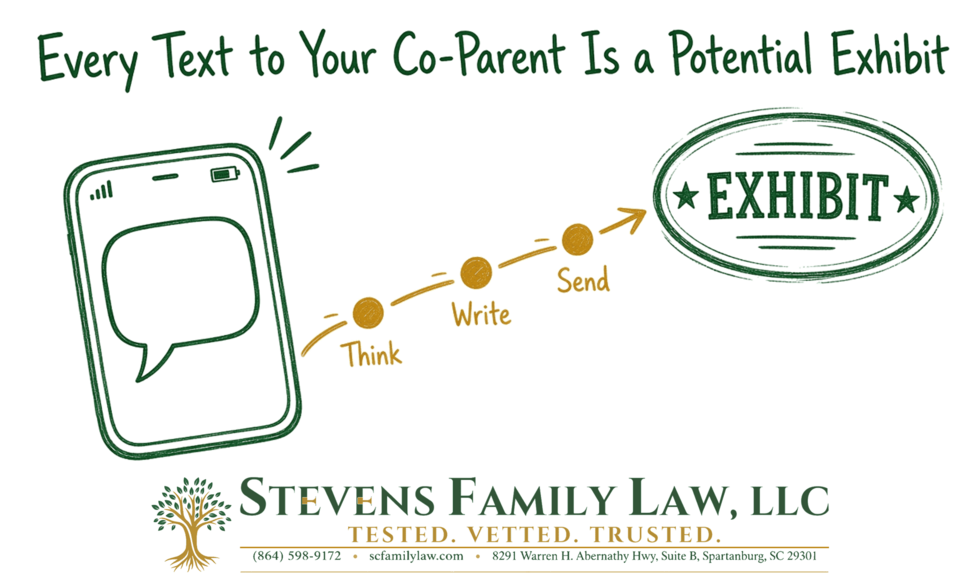
It is 11:40 at night and your phone buzzes. It is your child's other parent, and the message is unfair, or untrue, or simply cruel. You have half a reply written before you have finished reading it.
Put the phone down. In a South Carolina custody case, the written record between two parents is often the best evidence either side has about how they actually treat each other. Your reply is not a private argument. It is a document, and it will be read by someone who was not there.
That is not a reason to stop communicating. It is a reason to write differently. Every message you send your co-parent has two readers: the person it is addressed to tonight, and a Family Court judge or guardian ad litem who may read it a year from now, out of context, in a stack with two hundred others.
Why your messages end up in front of a judge
Parent-to-parent messages are easy to put into evidence and hard to argue with. They are dated, they are in your own words, and most of them were written before anyone was thinking about a hearing. A parent can explain away a bad afternoon on the witness stand. It is much harder to explain away fourteen months of messages.
We covered the evidence side of this — what helps, what hurts, why deleting is worse than whatever you wrote, and why you should never go looking in the other parent's accounts — in digital evidence in South Carolina divorce cases. This post is about the other half of the problem: what to do with the fact that your own messages are evidence.
Four best-interest factors your messages speak to
When a South Carolina court decides custody, § 63-15-240(B) directs it to “consider the best interest of the child” through a list of 17 factors. Four of them are, in practice, about how you communicate.
- Factor (6): “the actions of each parent to encourage the continuing parent-child relationship between the child and the other parent, as is appropriate, including compliance with court orders.”
- Factor (7): “the manipulation by or coercive behavior of the parents in an effort to involve the child in the parents' dispute.”
- Factor (8): “any effort by one parent to disparage the other parent in front of the child.”
- Factor (9): “the ability of each parent to be actively involved in the life of the child.”
Read those four together and a pattern shows up. The court is looking for which parent makes the other parent's relationship with the child easier, and which one makes it harder. Your messages are the clearest record of that you will ever produce. We walked through the whole list in the best-interest factors, explained.
How to write a message you would not mind a judge reading
Answer the question that was asked, and nothing else. Keep it to logistics — who, what, when, where. Leave the marriage out of it. If the message you received raises six grievances and one question about Thursday, answer the question about Thursday.
Cut the sarcasm. Sarcasm does not survive the trip to a courtroom; tone of voice is the first thing lost in a screenshot, and what is left reads as contempt. For the same reason, skip the long explanation of why you are right. Short is better. “Yes, that works. I will have her there at six” is a complete message.
Do not send it at 11:40 at night. Almost nothing between co-parents is an emergency at that hour, and a message written tired and angry reads exactly like a message written tired and angry. Draft it, sleep, and send it in the morning if you still want to.
Never route a message through your child, and never let your child read the thread. Factors (7) and (8) are aimed squarely at that, and of everything in this post, it is the one that does real damage to a child rather than to a case.
When the other parent is baiting you, the non-answer is the answer. A judge reading a long thread can see who escalated and who declined to. Being the second kind of parent is not weakness. It is the most useful thing you can do for your case, and it costs you nothing but the satisfaction of the reply you did not send.
What about co-parenting apps?
Some families use a co-parenting platform — an app that keeps a timestamped log of messages, holds a shared calendar and expense record, and in some cases flags inflammatory language before a message is sent. Parents sometimes agree to use one. Sometimes a court orders it.
Be clear about what such a tool does and does not do. A log preserves what you wrote, the good messages and the bad ones alike; it is not a shield, and it does not clean anything up. A tone-checking feature suggests, it does not rewrite, and it will not save a message that should not have been sent. The habit is what helps you. The app only makes the habit easier to keep and easier to prove.
Settle it in the parenting plan, not in a hearing
Section 63-15-220(A) requires each parent, at a contested temporary hearing, to file a parenting plan reflecting “the allocation of parenting time to be spent with each parent, and major decisions, including, but not limited to,” education, medical and dental care, extracurricular activities and religious training.
“Not limited to” is the useful phrase. A plan can also set how the two of you communicate: which method you will use, how quickly a non-emergency message gets a reply, what counts as an emergency, and that the children are not to be used as messengers. The statute does not require any of that. Nothing stops you from proposing it either, and terms agreed on a calm day are worth more than an argument about tone eighteen months later.
What this means for you
Here is the honest test. If every message you sent in the last year were printed and handed to a judge tomorrow, what story would they tell about you as a parent? Most people know the answer immediately.
If the answer worries you, the fix is not to delete anything — that is its own problem, and a worse one. The fix is that a judge reads a thread as a story, and a story can change direction. Start writing differently today and the record starts improving today.
And if the other parent's messages are the problem — threats, relentless hostility, refusing to follow the schedule — then the same record cuts the other way. That is evidence, and it may support asking the court to change a custody order that is not working.
If you are in danger, please do not work through this alone. The National Domestic Violence Hotline is available 24 hours a day at 1-800-799-7233.
Stevens Family Law, LLC is devoted exclusively to family law, and our attorneys handle custody and parenting-time matters in Family Courts across South Carolina. Much of what decides a contested custody case is built months before anyone files anything, one message at a time. You can reach our office at (864) 598-9172 or request a consultation.
This article is general information, not legal advice, and reading it does not create an attorney-client relationship. Custody decisions are highly fact-specific, and outcomes vary from case to case.



Comments
There are no comments for this post. Be the first and Add your Comment below.
Leave a Comment