
The support order was entered in the spring. By fall, your former spouse has left a salaried job for "consulting," or for nothing at all, and has filed to reduce support because the income is gone. You can't prove what is in anyone's head. You're fairly sure you know anyway.
South Carolina law has an answer for this. When a court finds that a parent is voluntarily unemployed or underemployed, it can calculate child support based on what that parent could earn, not what the parent is choosing to earn. The legal term is imputed income. The quote in our headline is how the question usually reaches us, but the rule applies the same way whichever parent's income drops.
What the guidelines actually say
South Carolina's Child Support Guidelines are set by regulation. They provide that if the court finds a parent voluntarily unemployed or underemployed, it should calculate support based on the parent's potential income, meaning the income that would otherwise ordinarily be available to that parent. We touched on this in our post on how child support is calculated. Here is the fuller picture.
The guidelines don't leave potential income to guesswork. They direct the court to look at the parent's real circumstances, including:
- Employment and earnings history, job skills, and education
- Age, health, and literacy
- Criminal record and other barriers to employment
- The parent's record of looking for work
- The local job market, whether employers are actually willing to hire the parent, and prevailing pay in the community
- The parent's assets and residence
There is one firm limit. Under the guidelines, a finding of willful or voluntary unemployment cannot be made when a parent's incarceration is what prevents them from working.
Voluntary doesn't have to mean bad faith
The question isn't only whether a parent quit to hurt the other parent. South Carolina's appellate courts have said a parent can be voluntarily underemployed even without a bad-faith motive. At the same time, courts are expected to look closely at the parent's explanation for earning less, and at whether that explanation is reasonable and offered in good faith.
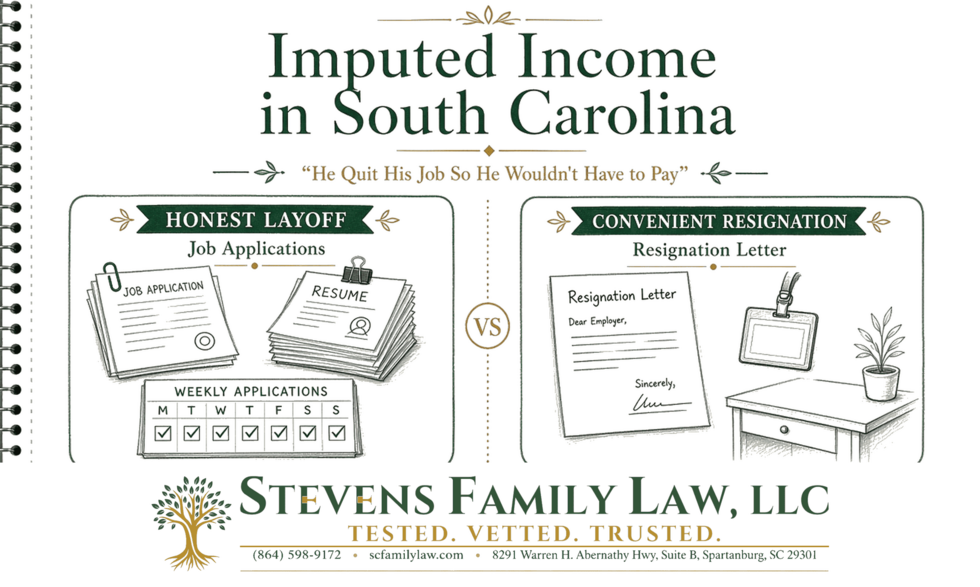
That is why the facts around the change matter so much. Take two hypothetical parents. One is laid off when a plant closes, applies for jobs every week, and takes a lower-paying position after four months. The other resigns from a well-paid job two weeks after being served with a support action and hasn't applied anywhere since. Both earn less than they used to. The law is built to tell those two situations apart.
Some changes are harder to judge. A parent who leaves a demanding job to spend more time with the children, goes back to school, or starts a business that hasn't turned a profit yet may have a sincere reason. The court still weighs that explanation against the children's needs, and there is no single answer for these situations. What the guidelines require is that the judge look at the whole picture, not just the pay stub.
The same idea applies to alimony
Alimony works on a similar principle. When a South Carolina court decides alimony, the statute directs it to consider the current and reasonably anticipated earnings of both spouses. "Reasonably anticipated" is doing real work in that sentence. The court isn't limited to what appears on this year's pay stub. Judges look at the same kinds of evidence there: work history, education, health, and what jobs actually exist.
And it cuts both ways. A spouse who asks for alimony while turning down work they are plainly able to do may find the court considering what they could earn, too.
When the drop comes after the order
Most of these disputes arise after support has been set, when the paying parent asks for a reduction. A real change in income can be grounds to modify support, and we have written about how modification works. But a court asked to lower support will want to know why the income changed, and a reduction the parent chose is a weak foundation for a request to pay less.
If you are the parent paying, understand that the existing order stays in force until a judge changes it. Reducing or stopping payments on your own, even after a genuine job loss, creates arrears and can lead to a contempt action.
What this means for you
Imputed income cases turn on evidence, not suspicion. Job postings in the other parent's field, their résumé and work history, the timing of the resignation, and what they have actually done to find work are what a judge weighs. Gathering that is lawyer work, and some of it takes formal discovery.
If your own income has honestly dropped, the lesson is the same in reverse. Document your job search from the first day, and ask the court to modify the order rather than simply paying less. Either way, our child support attorneys can help you see what the record shows.
Stevens Family Law, LLC is devoted exclusively to family law, and our attorneys handle child support and alimony matters in Family Courts across South Carolina. Whether you believe the other parent is hiding what they can earn or you need to show a court that your own drop in income is real, these cases turn on the record, and building that record is where we start. Call our office at (864) 598-9172 or request a consultation.
This article is general information, not legal advice, and reading it does not create an attorney-client relationship. The guideline provisions described here reflect the South Carolina Child Support Guidelines as amended effective February 23, 2024, and are revised periodically.



Comments
There are no comments for this post. Be the first and Add your Comment below.
Leave a Comment