
The decree was supposed to be the end. Then life kept happening. You lost a job, or your ex got a big promotion. The children got older and their needs changed. Someone remarried, moved, retired. And now you are reading an order signed years ago and wondering how much of it still has to be true.
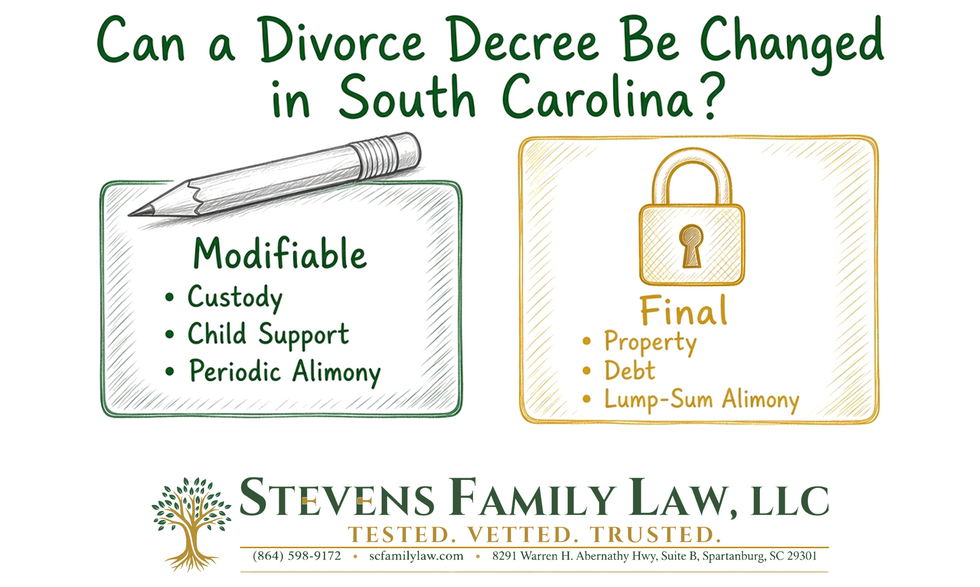
The short answer: some parts of a South Carolina divorce decree can be changed when circumstances change, and some parts are meant to be permanent. Custody, visitation, child support, and most periodic alimony fall in the first group. The division of property and debt, and several kinds of alimony, generally fall in the second.
Custody and visitation
Orders about children are never entirely final, because children change. The custody statute anticipates this. Section 63-15-240(B) applies "in issuing or modifying a custody order" and directs the court to consider "the best interest of the child."
What it takes to reopen custody — the showing a parent has to make before the court will look at a new arrangement — comes from South Carolina case law rather than the statute, and it is a meaningful hurdle. We walked through it in can you change a custody order in South Carolina.
Child support
Child support can also be revisited when circumstances change, and when it is, the statewide guidelines are the starting point for the new number. The usual reasons are a real change in either parent's income, a change in where the children live, or a change in their needs.
One caution cuts the other way. A drop in income the paying parent chose may not help at all, because the court can set support based on what a parent could earn. We covered that in imputed income in South Carolina.
Alimony depends on the type
South Carolina recognizes several types of alimony, and § 20-3-130(B) spells out which can be changed. Periodic alimony is "terminable and modifiable based upon changed circumstances occurring in the future." Lump-sum alimony is "not terminable or modifiable based upon remarriage or changed circumstances in the future," and reimbursement alimony likewise is "not terminable or modifiable based upon changed circumstances in the future." Rehabilitative alimony sits in between: it is modifiable based on unforeseen events that frustrate the supported spouse's good-faith efforts or affect the paying spouse's ability to pay.
For periodic alimony, § 20-3-170(A) allows either party to apply to the court when "the circumstances of the parties or the financial ability of the spouse making the periodic payments shall have changed" since the judgment. Retirement gets its own treatment in § 20-3-170(B), which directs the court to consider, among other things, whether the retirement was contemplated when alimony was awarded, the paying spouse's age and health, whether the retirement was mandatory or voluntary, and the resulting drop in income.
Then there is the sentence that can override all of it. Section 20-3-130(G) provides that "the parties may agree in writing if properly approved by the court to make the payment of alimony ... nonmodifiable and not subject to subsequent modification by the court." If your agreement contains a clause like that, the changed-circumstances route may be closed, whatever has happened since. Read your agreement before you assume anything.
Property and debt division
The division of property and debt is meant to be final. No provision of the divorce statute provides for modifying an equitable division once it is complete, and the policy is easy to understand: people need to be able to rely on what they were awarded, sell it, refinance it, and move on. Reopening a property division is possible only in narrow circumstances, such as fraud, under rules and case law that set a high bar.
Modification is not enforcement
One more distinction trips people up. If your ex is not doing what the decree already requires — not paying, not transferring an account, not signing a deed — you do not need to change the order. You need to enforce it. We covered that separately in how to enforce a divorce decree in South Carolina. The Family Court has authority both "to modify or vacate any order issued by the court" (§ 63-3-530(A)(25)) and to enforce its orders through contempt, but they are different requests with different proof.
What this means for you
Start with the documents. Read the decree and any agreement it approved, line by line, for what they say about modification. Then look carefully at what has changed, when, and whether you chose it. And keep following the order while you ask to change it. A decree you think is out of date is still a decree, and paying less or doing less on your own creates a second problem on top of the first.
Stevens Family Law, LLC is devoted exclusively to family law, and our attorneys handle modification and enforcement matters in Family Courts across South Carolina. Whether a decree can be changed often turns on a few sentences written years ago, and on what can be shown about what has happened since. Call us at (864) 598-9172, or start with our consultation form.
This article is general information, not legal advice, and reading it does not create an attorney-client relationship. Whether a particular decree can be modified depends on its exact terms and on the facts, and outcomes vary from case to case.



Comments
There are no comments for this post. Be the first and Add your Comment below.
Leave a Comment