
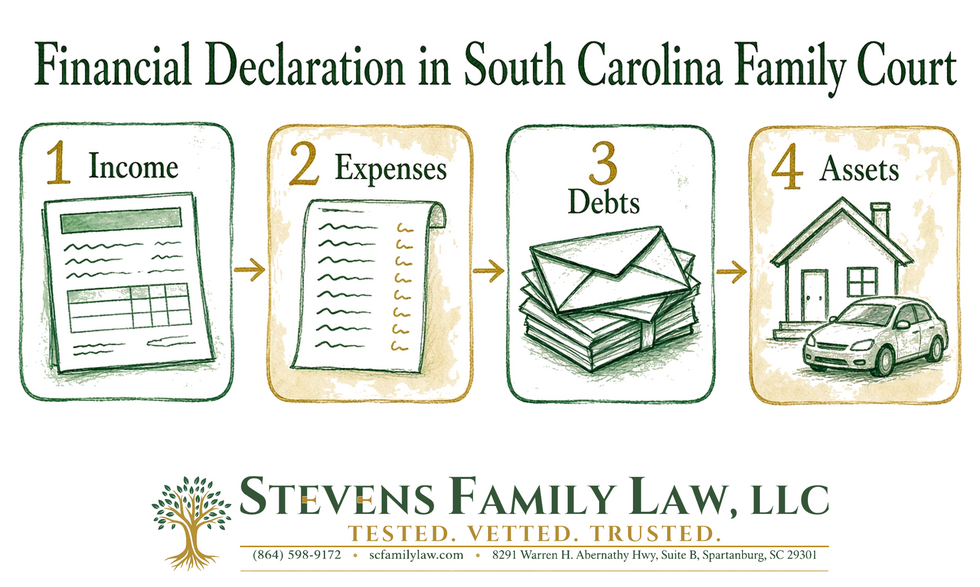
A financial declaration is the sworn form, filed in South Carolina Family Court, on which you list your monthly income, payroll deductions, monthly expenses, debts, and assets. The court uses it to decide child support, alimony, property division, and temporary relief, so a form that is incomplete or wrong can cost you in a divorce, a support case, and even a custody case where money is in dispute.
That is the short answer. The longer one matters because nearly every client asks the same question when the form arrives: why does the other side get to see all of this? Because the court cannot decide anything about money without it.
What a financial declaration is
The financial declaration is a standard statewide court form. The current version is SCCA 430, revised in November 2024, and it is available on the South Carolina Judicial Branch website. A short-form version, SCCA 430S, also exists. You sign the declaration in front of a notary, which means you are swearing that what it says is true.
Rule 20 of the South Carolina Rules of Family Court makes it mandatory. In any domestic relations action "in which the financial condition of a party is relevant or is an issue to be considered by the court," every party must serve and file a current financial declaration. The deadline is "prior to or at the first hearing, or no later than 45 days after the complaint is served, whichever occurs first."
That rule reaches more cases than people expect. A case that starts as a custody dispute becomes a money case the moment either side asks for child support, or asks the court to make the other side pay attorney's fees.
What you list
The form is built around a month. It asks for:
- Gross monthly income from every source: wages, overtime and bonuses, retirement income, Social Security and VA benefits, support from another relationship, dividends and interest, rental income and business profits.
- Payroll deductions, such as taxes, insurance, and retirement contributions.
- Monthly expenses for your household: housing, utilities, food, transportation, child care, the children's school costs, and the rest of a real budget.
- Debts, including installment loans and other obligations, who you owe, what you pay, and whether anything is behind.
- Assets: marital property in one section, and any property you claim is non-marital in a separate section. If total assets are more than $300,000, the form requires you to itemize them account by account.
Two things trip people up. The first is arithmetic. The form wants monthly figures, and few people are paid monthly. Its instructions say that if you are paid every two weeks, you multiply one gross paycheck by 26 and divide by 12. Simply doubling a paycheck understates your income, and the other side will notice. The form also asks for a recent pay stub to be attached.
The second is the budget. Expenses should be what you actually spend, or, if you have just separated, what your new household will realistically cost. Not what you wish you spent, and not a number built to make the other side look bad. Family Court judges read a great many of these. An inflated budget is not hard to spot.
How the court uses it
The financial declaration feeds almost every money decision the Family Court makes.
Child support. South Carolina calculates support from both parents' incomes, and the declaration is where those incomes are first set down under oath. We explained the math in how child support is calculated in South Carolina. When one side claims the other could be earning more, the declaration is the starting point for an argument about imputed income.
Alimony. The alimony statute directs the court to weigh, among other factors, "the current and reasonably anticipated earnings of both spouses" and "the current and reasonably anticipated expenses and needs of both spouses." S.C. Code § 20-3-130(C). The income and expense pages of your declaration are where both of those begin.
Property and debt. The asset and debt sections are the first inventory of what the marriage owns and owes. They are the raw material for equitable apportionment, the legal term for dividing marital property and debts, which in South Carolina does not automatically mean an even split. The statute requires the court to consider, among other things, "liens and any other encumbrances upon the marital property" and "any other existing debts incurred by the parties or either of them during the course of the marriage." S.C. Code § 20-3-620(B).
Temporary relief. At a temporary hearing, where the court sets the rules for the months while a case is pending, the declarations are often the main financial evidence in front of the judge. A careless declaration filed in the first weeks can shape a temporary order that lasts much longer than anyone planned.
Why an incomplete or wrong declaration hurts
The first cost is credibility. The declaration is sworn. When a number on it turns out to be wrong, whether an account left off, income understated, or a budget padded, the damage is rarely confined to that one number. The judge now has a reason to doubt everything else you say. In a case decided by a judge, including a custody case, credibility is most of what you have.
The second is that omissions get found. Bank statements, tax returns, and pay records can all be obtained by the other side through discovery, the formal exchange of information in a lawsuit. A mistake you correct on your own looks like a mistake. The same mistake uncovered by opposing counsel looks like something else.
The third is the rule itself. Rule 20 provides that "reasonable sanctions may be imposed upon an attorney or a party for willful noncompliance with this rule." And a sworn document that is knowingly false raises problems far more serious than a sanction.
Finally, a declaration is a snapshot, and snapshots age. The rule calls for a current declaration. If your income changes, you change jobs, you open or close an account, or a large expense begins or ends, your declaration needs updating. A good working rule is that a current one should exist before every hearing.
What this means for you
Start early. Gather your most recent pay stubs and tax return, statements for every account, current loan balances, and a few months of bank and credit card statements to build an honest budget from. When you are unsure whether something belongs on the form, list it and let your lawyer sort out how it should be classified. Leaving it off is the mistake that is hard to undo.
Then read the final version line by line before you sign it. Your lawyer helps prepare it. You are the one swearing to it.
Stevens Family Law, LLC is devoted exclusively to family law, and our attorneys handle divorce, support, and property matters in Family Courts across South Carolina. A financial declaration done carefully at the start of a case prevents arguments at the end of it, and it is one of the first things we work through with a new client. Call our office at (864) 598-9172, or request a consultation.
This article is general information, not legal advice, and reading it does not create an attorney-client relationship. Court forms and rules are revised from time to time, so confirm you are using the current version of the financial declaration before you file.



Comments
There are no comments for this post. Be the first and Add your Comment below.
Leave a Comment