
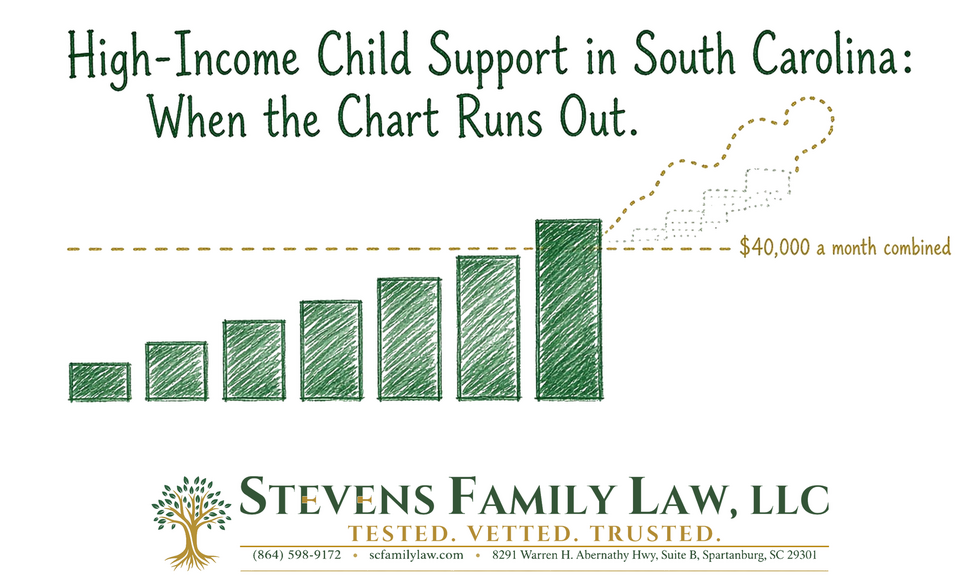
You plugged the numbers into a child support calculator and it stopped working. Maybe one of you is a surgeon, or owns the business, or had a year with a large bonus or a sale. Together you earn more than the chart was built for, and now nobody can tell you what the number is supposed to be.
That is not a glitch. South Carolina's child support guidelines simply stop calculating at a certain income, and above that line the law hands the question to the judge. That sounds open-ended, and in a sense it is. But it is not a blank check for either side, and the families who handle these cases well are the ones who understand what the court will actually be looking at.
Where the chart stops
South Carolina sets child support using guidelines adopted by regulation and published by the Department of Social Services. The current version is the 2024 edition. It says so plainly: "These guidelines provide for calculated amounts of child support for a combined parental gross income of up to $40,000 per month, or $480,000 per year. Where the combined gross income is higher, courts should determine child support awards on a case-by-case basis." S.C. Code Regs. 114-4710(A)(3).
Two things follow from that sentence, and both surprise people. The guidelines do not say support stops at the top of the chart, so the highest figure on the schedule is not a ceiling. And they do not say support keeps climbing in a straight line as income rises. They say the court decides, family by family.
If you have read older articles on this subject, check the number they use. Material written under earlier editions of the guidelines may cite a lower threshold. The 2024 figure is $40,000 a month in combined gross income.
First, the court has to decide what the income is
Before anyone argues about the amount, there is often an argument about the income itself, and in high-income families that fight can be the bigger one. The guidelines define gross income broadly, as "income from any source," including salaries, commissions, bonuses, rents, dividends, interest, trust income, capital gains, and more. S.C. Code Regs. 114-4720(A)(2). The court may also consider assets that could generate income, and if a parent is voluntarily unemployed or underemployed, it can base support on potential income instead. We covered that second point in our post on imputed income in South Carolina.
Business owners get particular attention. The guidelines tell the court to "carefully review income and expenses from self-employment or operation of a business" to find the income actually available for support, and they note that this amount "may differ from the determination of business income for tax purposes." S.C. Code Regs. 114-4720(A)(4). In other words, the number on the tax return is where the analysis starts, not where it ends.
That review usually decides which side of the $40,000 line a family is on. Our post on how child support is calculated in South Carolina walks through how income feeds the calculation when the guidelines do apply.
What "case by case" looks like
Inside the guidelines, the calculated amount carries real weight. By statute, it is a rebuttable presumption — the amount a court should award unless someone shows it would be unjust or inappropriate — and when a judge moves significantly away from it, the judge must make specific written findings explaining why. S.C. Code § 63-17-470(A).
Above the line, there is no calculated amount to presume. The judge has to build the number from the evidence. The statute's list of reasons a court may depart from the guidelines gives a sense of the issues that come up: education expenses such as private school tuition, the division of property, significant income of the child, a substantial disparity in the parents' incomes, and alimony. S.C. Code § 63-17-470(C). In practice, the most persuasive evidence is usually concrete: what the children's lives actually cost, and how they have actually been living.
That cuts both ways. A parent asking for support well above the top of the chart needs to show what the children need, not just what the other parent earns. A parent resisting that request needs a credible picture of the same expenses, not just an argument that the number is too high. In these cases, the side with the better budget usually has the better argument.
Agreements still work, with a check
Many high-income families settle child support rather than try it, and the law allows that. The court may approve an agreed amount if both parents have lawyers, or if it thoroughly examines an unrepresented parent and finds that parent fully understands the agreement. The court keeps "the discretion and the independent duty to determine if the amount is reasonable and in the best interest of the child(ren)." S.C. Code Regs. 114-4710(B)(12). A private agreement on support is a starting point for the judge, not the last word.
If you are heading into negotiation or a hearing in one of these cases, these are the records that tend to matter most:
- Personal tax returns for several years, with every schedule, plus W-2s, 1099s, and K-1s
- Business tax returns, financial statements, and records of distributions and owner perks
- A month-by-month accounting of what the children actually cost: tuition, activities, travel, health care, childcare
- Evidence of how the household lived before the separation: housing, vacations, schools, and routines
What this means for you
If you are the higher earner, do not assume the top of the chart is the most you could owe, and do not assume a judge will simply extend the chart upward either. Expect the court to look hard at your real income and at what your children's lives cost.
If you are the parent asking for support, the strength of your case is in the detail. A well-documented budget that matches how the children have actually lived is worth more than a percentage of the other parent's income.
Either way, these cases reward preparation more than most. The guidelines give a judge a lot of room above $40,000 a month, and the evidence decides how that room gets used.
Stevens Family Law, LLC is devoted exclusively to family law, and our attorneys handle high-income and complex-asset cases in Family Courts across South Carolina, including child support disputes where the guidelines run out. If your family's income is above the chart, it is worth understanding what a court will look at before you put a number on the table. Call us at (864) 598-9172, or start with our consultation form.
This article is general information, not legal advice, and reading it does not create an attorney-client relationship. Child support above the guidelines is set case by case, and outcomes depend heavily on the evidence in each family's case.



Comments
There are no comments for this post. Be the first and Add your Comment below.
Leave a Comment